




Revolutionize GI Bleed Detection
PillSense is the most accurate way to diagnose upper GI Bleeds
Experience the cutting-edge technology of the PillSense GI Bleed Detection System, designed to transform patient care with unparalleled accuracy and efficiency.
Technical Specifications
Pillsense Capsule |
Dimensions & Specifications |
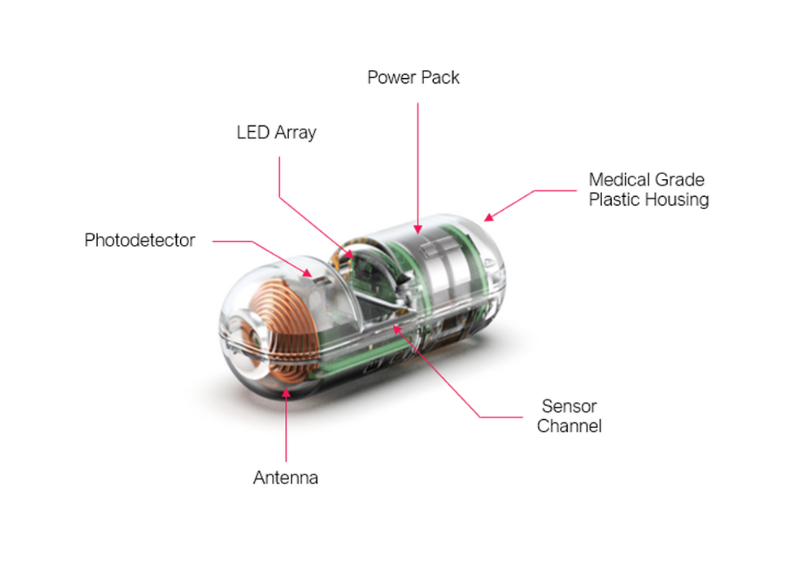
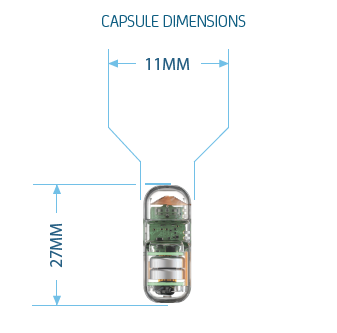
The PillSenseTM Capsule (11x27mm) is a single-patient use device which features an optical sensor which detects blood and wirelessly transmits data to the battery-powered PillSense Receiver.
The optical sensor contained in the PillSense Capsule detects the presence of liquid blood and/or hematin by analyzing the absorption of multiple wavelengths of light of the environment in which it is immersed.
The data are then processed by an algorithm and results are displayed in real-time by the PillSense Receiver as a simple and definitive message “Blood detected” or “No blood detected”. From the time of PillSenseTM Capsule activation and ingestion until the result message is displayed takes less than 10 minutes.
| LENGTH | 27mm |
| MAXIMUM DIAMETER | 11mm |
| MATERIAL | Biocompatible plastic |
| BLOOD SENSING TECHNOLOGY | Multiple light emitting diodes at different wavelengths and one optical sensor detector |
| OPERATING TEMPERATURE | In-vivo conditions |
| STORAGE CONDITIONS | Normal indoor environmental conditions |
Pillsense Receiver |
Dimensions & Specifications |
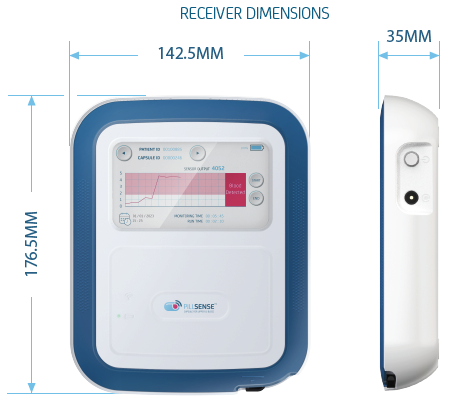
The PillSense Receiver displays in real-time the data transmitted wirelessly from the capsule and provide a binary final results as a simple and definitive message “Blood detected” or “No blood detected.
| LENGTH | 176.5mm |
| WIDTH | 142.5mm |
| BATTERY LIFE | Biocompatible plastic |
| SERVICE LIFE | 2 years |
| OPERATING TEMPERATURE |
Normal indoor environmental conditions:
|
| STORAGE CONDITIONS |
|
Rapid Results that clearly make sense
The PillSense GI Bleed Detection System is the first FDA-approved ingestible blooddetection system that can rapidly and accurately detect upper GI bleeding using light absorption technology. Use the PillSense Capsule to efficiently triage and prioritize patients with suspected GI bleeding and confirm bleeds in hemodynamically stable patients. It’s designed to enhance your risk stratification and decision making for a more efficient use of critical resources
Clinical Proven Accuracy
%
Sensitivity
%
Specificity
PillSense GI Bleed Detection System FAQ
Discover answers to common questions about the PillSense system to better understand its application and benefits.
What is PillSense™ and how does it work?
PillSense is a first-line diagnostic ingestible that’s designed to transform upper gastrointestinal bleeding (UGIB) diagnosis and optimize patient management. PillSense is the first FDA-approved ingestible blood detection system to rapidly and accurately1 detect upper GI bleeding using light absorption technology. The PillSense System consists of an ingestible capsule featuring an optical sensor that detects blood in the upper GI tract and wirelessly transmits data to the PillSense Receiver. The results are displayed in real-time by the PillSense Receiver as a simple and definitive message: “Blood Detected” or “No Blood Detected.”
What is UGIB?
Upper gastrointestinal bleeding (UGIB) is a common problem that is described as blood loss from a gastrointestinal source above the ligament of treitz (esophagus, stomach, and duodenum).
Which patients can benefit from PillSense?
PillSense can be used in most hemodynamically stable adults suspected of having upper gastrointestinal bleeding (UGIB). PillSense is contraindicated in patients with the following conditions: hemodynamic shock, cardiac pacemakers or other implanted electronic devices, known or suspected gastrointestinal obstructions, strictures, or fistula, Chron’s disease (CD) and/or other inflammatory bowel disorders, gastroparesis, swallowing disorder or difficulties in swallowing the capsule. Healthcare professionals can use PillSense to efficiently triage and prioritize patients with suspected GI bleeding. It can enhance risk stratification and decision making for a more efficient use of critical resources.
Who can administer PillSense?
PillSense is simple to use and is administered by a trained healthcare professional. Results are provided almost immediately and do not require interpretation by specialized medical staff.
How accurate are PillSense results?
PillSense can provide accurate results in under 10 minutes, with 93% sensitivity and 91% specificity.
What size is the PillSense Capsule?
The PillSense Capsule is the same size as a multi-vitamin capsule, measuring 11x27mm.
How long does a procedure take using PillSense?
PillSense can provide accurate results in under 10 minutes with 93% sensitivity and 91% specificity.¹ After a healthcare professional pairs the PillSense Capsule with the receiver, the patient ingests the capsule with a full glass of water. After ingestion the patient lies on their left-hand side during the monitoring phase. The clear “Blood Detected” or “No Blood Detected” result is then displayed on the receiver.
How long does it take for the capsule to pass?
In a clinical study, the PillSense Capsule cleared the gastrointestinal (GI) tract within a mean of 3.6 days (mean 3 days; range 0-9).¹ The patient should observe their stool for capsule passage. If the patient has not positively verified the excretion of the capsule from their body, they should contact the physician for evaluation and a possible abdominal x-ray before undergoing an MRI evaluation.
Are there any post-procedural recommendations when using PillSense?
Once the procedure is complete, the patient can immediately resume their normal diet and activities. After ingesting the PillSense Capsule, and until it is excreted, the patient should not undergo an MRI. If the patient experiences any abdominal pain, nausea, or vomiting after ingesting the PillSense Capsule, they should consult their physician.
After the procedure, how is the PillSense Capsule removed from the body?
The PillSense Capsule will naturally pass from the patient’s body. There is no need to collect the capsule after excretion. Once the procedure is complete, the patient can resume their normal diet and activities.
How close should the PillSense Receiver be to the PillSense Capsule?
The receiver can be held in close proximity to the capsule (within 2 m/6.5 feet). It does not require any leads or a physical connection to the patient’s torso.
How long should the healthcare professional monitor for results?
When the capsule is immerged in fluid that contains blood, the message “Blood Detected” will appear almost immediately. However, if no blood is present in the surrounding environment, a minimum of 5 minutes of monitoring is required to achieve a definitive “No Blood Detected” result. Monitoring can continue for up to 40 minutes at the discretion of the ordering healthcare provider.
Can you connect multiple capsules to the same receiver?
The PillSense Receiver is reusable; however, a healthcare professional can only pair the receiver with one capsule at a time.
How does PillSense compare to traditional methods of UGIB diagnosis?
Existing upper gastrointestinal bleeding (UGIB) diagnostic tools may include clinical scores (e.g., Glasgow blatchford score), nasogastric tube lavage, and laboratory (blood) tests. These solutions may at times be inaccurate, require time to process, and may be invasive and uncomfortable for the patient. In contrast, PillSense is a rapid, simple, and accurate diagnostic¹ that is designed to detect blood in the upper GI tract. It is non-invasive and rapidly provides a definitive “Blood Detected/No Blood Detected” result, which does not require image or data interpretation by specialized medical staff.
What is the difference between PillSense and capsule endoscopy?
PillSense is designed to detect blood within the upper gastrointestinal (GI) tract. PillSense provides a binary and definitive “Blood Detected/No Blood Detected” result based on the presence or absence of blood in the upper GI tract. It does not require specialized physician interpretation. Alternatively, capsule endoscopy often requires bowel preparation and fasting. Once swallowed, the capsule endoscopy records images of the GI tract, which must be downloaded and interpreted before being reported by a trained physician.
Does PillSense identify the source of bleeding?
PillSense is designed to detect blood within the environment in which it is immerged. It does not collect gastrointestinal (GI) images or video; therefore, the source of bleeding is not determined. PillSense provides a binary and definitive “Blood Detected/No Blood Detected” result based on the presence or absence of blood in the upper GI tract. In a clinical study¹ the PillSense Capsule was accurate in identifying blood from esophageal, gastric, and duodenal sources.
Can the PillSense data transmission interfere with any other devices in or around the patient?
The capsule transmits data to the receiver using radio frequency (RF) communication. The capsule uses RF energy only for its internal function; therefore, the RF emissions are low and unlikely to cause any interference to nearby electronic equipment. NOTE: the presence of portable and mobile RF communications may affect the PillSense system. PillSense should be used away from any active MRI machine and particular precautions should be used near other machines that could cause electromagnetic (EM) interference and loss of data. Additional information can be found in the product’s IFU.
Does PillSense detect dried blood, commonly referred to as “coffee ground” emesis?
Yes, a clinical study1 demonstrated that PillSense can detect a wide variety of blood types, from fresh active blood to coffee-ground-like hematin in the stomach. When the patient drinks water with the capsule, the hematin dilutes into the gastric environment, making it easier to detect diluted liquid blood. Since gastrointestinal (GI) bleeds can be intermittent, it is important that the device detect hematin to avoid missing “recently active bleeding.” However, if a bleeding has stopped for a prolonged period of time, most of the digested blood will likely have cleared, resulting in a “no blood detected” result.
Book your Demo Today
Kindly fill out the form below to initiate a conversation and a member of our team will reach out to you.
* We’ll get back to you in 1-2 business days